Tel: +971 4 396 7982
Mobile: +971 55 989 3299
Email: info@guptaaccountants.com

A Comprehensive Guide for Businesses in DMCC, JAFZA, IFZA, DIFC & More
A comprehensive VAT compliance guide for DMCC, JAFZA, IFZA, DIFC, and more. Understand rules and stay compliant with expert VAT support.
Gupta Group International
1/9/20265 min read


A Comprehensive Guide for Businesses in DMCC, JAFZA, IFZA, DIFC & More
VAT Filing in UAE Free Zones: A Comprehensive Guide for Businesses in DMCC, JAFZA, IFZA, DIFC & More :
The United Arab Emirates (UAE) has rapidly evolved into a global business and logistics hub. One of the major milestones in its economic transformation was the introduction of Value Added Tax (VAT) on 1 January 2018. While VAT applies across the UAE at a standard rate of 5%, the rules governing VAT in Free Zones differ significantly from those in the Mainland. For businesses operating in Free Zones such as DMCC, JAFZA, IFZA, DIFC, and others, understanding VAT filing requirements is crucial—not just for compliance, but also for maximizing business efficiencies.
Whether you’re a start-up in a Free Zone, an experienced tax advisor, or a multinational with regional operations, this guide will help you navigate the complexities of VAT filing in UAE Free Zones.
Introduction to VAT in the UAE :
The introduction of VAT in the UAE represented a major shift in the country’s indirect tax framework. At 5%, this relatively low rate was designed to be business-friendly while creating a stable revenue source for the government. The VAT system, governed by Federal Decree-Law No. (8) of 2017 and its executive regulations, requires businesses to:
Register for VAT (if eligible or required)
Charge VAT on taxable supplies
Issue compliant tax invoices
Submit periodic VAT returns
Maintain accurate financial records
While the framework is standard nationwide, special provisions apply to Free Zones. This blog dives deep into how VAT works in Free Zones and what every business needs to know about VAT filing.
What Are Free Zones in the UAE ?
Free Zones are geographically defined areas where companies can operate under specific economic regulations that differ from the Mainland. The primary goals of Free Zones are to:
Attract foreign investment
Simplify business setup
Provide tax exemptions and repatriation of profits
Create focused industry clusters (e.g., logistics, tech, finance)
Some of the most well-known Free Zones include:
DMCC (Dubai Multi Commodities Centre)
JAFZA (Jebel Ali Free Zone Authority)
IFZA (International Free Zone Authority)
DIFC (Dubai International Financial Centre)
Abu Dhabi Global Market (ADGM)
Ras Al Khaimah Economic Zone (RAKEZ)
Sharjah Airport International Free Zone (SAIF Zone)
Every Free Zone has its own regulatory authority and set of incentives, but VAT compliance is governed by Federal Tax Authority (FTA) with specific rules for Free Zones.
VAT in UAE: Mainland vs Free Zones :
Mainland :
For businesses in the Mainland:
All local supplies of goods or services are taxable (standard rated or zero-rated)
VAT is charged at 5%
VAT returns are submitted quarterly (or monthly if turnover dictates)
Free Zones :
Free Zone businesses may be treated differently depending on whether the Free Zone is categorised as:
Designated Zone
Non-Designated Zone
This distinction affects :
Whether supplies are treated as exports
When VAT is charged
How VAT returns are filed
Categorization of Free Zones for VAT Purposes :
1) Designated Zones :
A Designated Zone is a Free Zone treated as being outside the UAE for VAT purposes. In practical terms:
Movements of goods between the Designated Zone and the UAE Mainland may be treated as import/export
Supplies may be treated as zero-rated or non-taxable, depending on the situation
Filing requirements change based on transaction type
Examples of Designated Free Zones include:
JAFZA
RAKEZ
KIZAD
Others as defined by FTA
2) Non-Designated Zones
In Non-Designated Zones:
VAT is applied like Mainland transactions for goods and services
Supplies within the Free Zone or to the Mainland are treated as local supplies
Examples include:
DIFC
ADGM
IFZA (note: treatment varies depending on the type of supply)
Understanding whether your Free Zone is designated or not is the first step in accurate VAT filing.
VAT Registration in Free Zones :
1) Who Must Register?
A business must register for VAT in the UAE if:
Taxable supplies and imports exceed the mandatory registration threshold (currently AED 375,000)
Voluntary registration is optional if supplies exceed AED 187,500
2) Free Zone Considerations
Free Zone businesses must consider:
Supplies treated as exports
Supplies made inside the Free Zone vs to the Mainland
Free Zone designated status
Importantly, a business cannot avoid VAT registration simply by being in a Free Zone. If your taxable activities exceed the threshold, registration with the FTA is mandatory.
VAT Filing Obligations for Free Zone Businesses :
Once registered for VAT, businesses (including those in Free Zones) must :
Submit VAT returns (usually quarterly)
File and pay VAT on time
Maintain compliant accounting records
Issue tax invoices with correct details
Submit adjustments, corrections, and supplements
The VAT return (Form VAT201) summarizes:
Total output VAT (tax on sales)
Total input VAT (tax on purchases)
VAT payable or refundable
Free Zone businesses often encounter unique filing requirements due to cross-border transactions, movement of goods, and differing tax treatments.
VAT Treatment by Free Zone :
1) DMCC (Dubai Multi Commodities Centre) :
Key points:
Considered a Non-Designated Free Zone.
VAT applies to supplies made within the Free Zone like domestic transactions.
Supplies from DMCC to Mainland are taxable local supplies.
Certain transactions may qualify for zero-rate if treated as exports outside the UAE.
DMCC companies must file VAT quarterly or monthly based on turnover.
Practical implications:
VAT on intra-Free Zone services unless zero-rated
Careful documentation needed for export zero-rating
VAT Filing Tips for DMCC:
Maintain clear records of goods movements
Differentiate local vs exported supply
Invoice correctly with VAT treatment declared
2) JAFZA (Jebel Ali Free Zone Authority) :
Key points:
Recognized as a Designated Zone for VAT purposes.
Goods movements from JAFZA to Mainland are generally treated as import/export.
Import VAT may apply upon entry into Mainland.
Services may be treated per the place of supply rules.
Benefits:
Exports of goods outside UAE may be zero-rated
Movement of goods within the designated zone may not attract VAT
VAT Filing Tips for JAFZA:
Track entries and exits of goods meticulously
Use customs declarations to support export zero-rating
Correct classification reduces the risk of misfiling
3) DIFC (Dubai International Financial Centre)
Key points:
Non-Designated Zone with its own legal system
VAT treatment depends on the nature of supplies
Financial supplies often have special VAT rules (exempt or zero-rate)
Supplies to Mainland customers are taxable
Unique features:
Services to non-UAE clients can be zero-rated if export conditions are met
Financial services may be excluded or treated as exempt
VAT Filing Tips for DIFC:
Validate place-of-supply rules for each transaction
Understand exemptions for specific financial supplies
4) IFZA (International Free Zone Authority)
Key points:
IFZA’s VAT treatment depends on whether goods/services are supplied within the zone or to the Mainland
Not always treated as a designated zone for goods unless specified
Services may be governed by general place-of-supply rules
VAT Filing Tips for IFZA:
Check whether goods movements qualify as imports/exports
Distinguish between services to UAE clients and outside
Ensure proper documentation
5) Other Free Zones (ADGM, RAKEZ, SAIF, etc.) :
ADGM (Abu Dhabi Global Market)
Like DIFC, not a designated goods zone
Special rules for financial and professional services
RAKEZ (Ras Al Khaimah Economic Zone)
Recognized as a Designated Zone for goods
VAT on goods may be treated as import/export
SAIF Zone (Sharjah Airport International Free Zone)
Generally designated for goods similar to other logistical Free Zones
General Filing Tips for Other Free Zones:
Know your zone’s status (designated vs non)
Reconcile customs data with VAT returns
Ensure clear export documentation for zero-rating
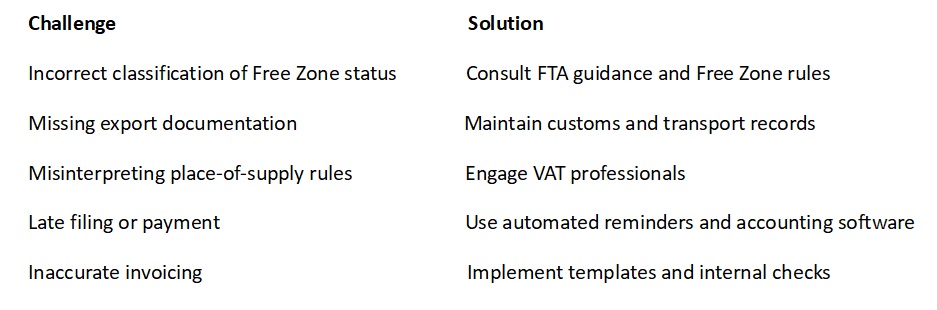
Common VAT Filing Challenges & How to Avoid Them :
Top causes of penalties include:
Filing late
Under-reporting VAT liability
Missing invoices or incorrect documentation
Misapplying zero-rating
Penalties for Non-Compliance :
Failure to comply with VAT regulations can lead to:
Fines for late registration
Penalties for late VAT returns
Late payment surcharges
Interest on unpaid amounts
Penalties for incorrect invoices
For Free Zone businesses, improper treatment of goods movements or exports is a frequent compliance risk.
How UAE-VATFiling.com Can Help :
At uae-vatfiling.com, we specialize in:
✅ Accurate VAT registration for Free Zone businesses
✅ VAT return preparation & filing
✅ Advisory on complex transactions (exports, logistics, financial services)
✅ Documentation support
✅ Audit support and penalty mitigation
Whether you operate in DMCC, JAFZA, DIFC, IFZA, or any other Free Zone, having an experienced VAT partner reduces risk and ensures operational confidence.
Navigating VAT filing in the UAE’s Free Zones requires a solid understanding of:
Free Zone classification (designated vs non-designated)
VAT registration obligations
Place of supply rules
Export documentation for zero-rating
Accurate and timely VAT returns
While Free Zones offer business advantages, VAT compliance remains mandatory and complex—especially when goods and services cross different jurisdictions.
By staying informed and leveraging professional support like uae-vatfiling.com, businesses can not only achieve compliance but also improve operational efficiency and avoid costly penalties.
© 2026 www.uae-vatfiling.com